
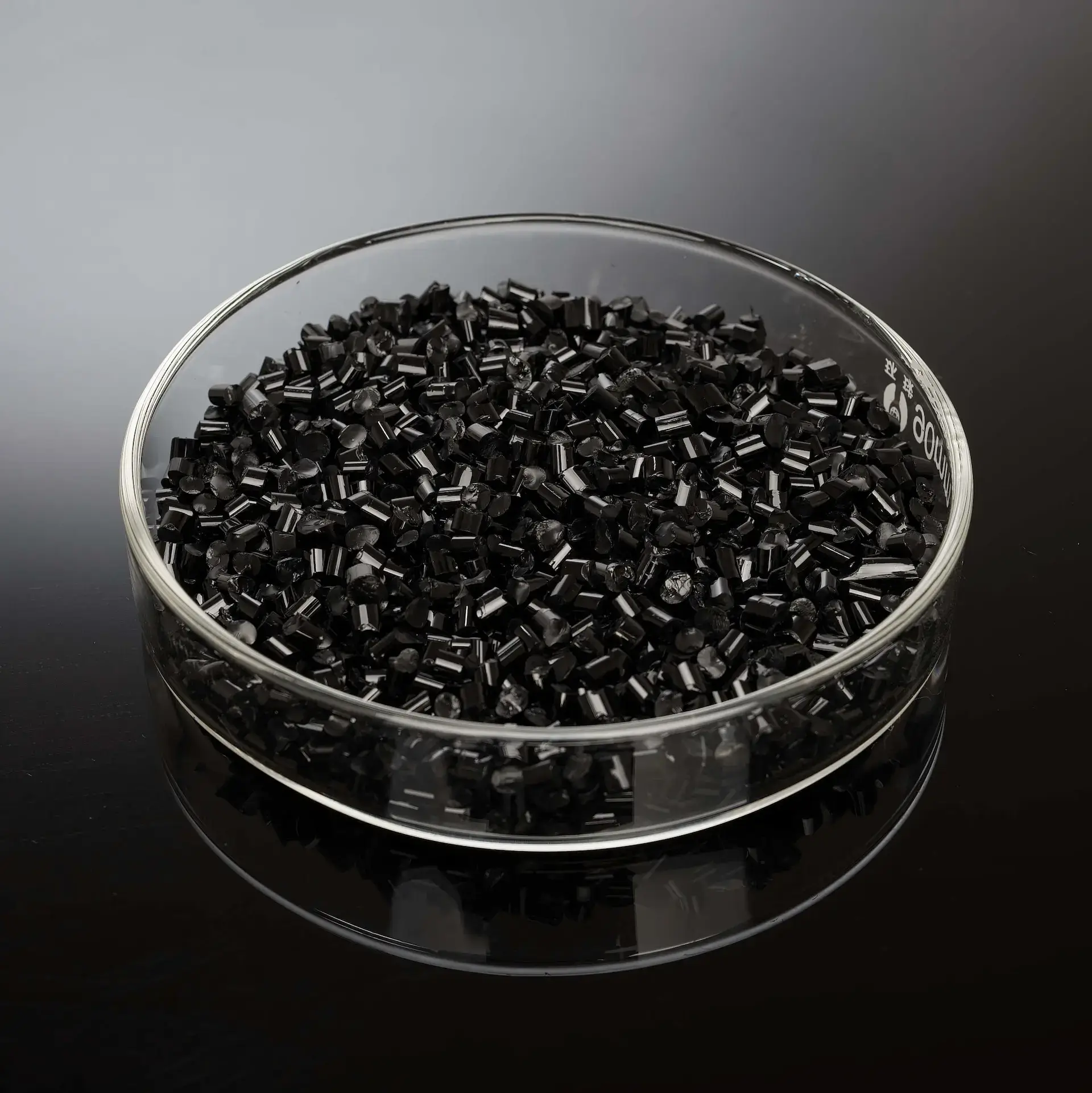
In automotive interiors and consumer electronics, “black” is not a uniform specification. OEMs routinely reject molded components because the surface appears grey, hazy, or milky under directional showroom lighting. When engineering a deep, high-gloss piano black component, quality control managers often blame the mold texture or cycle times for a dull finish. While tool semantics matter, the root cause of surface haze is almost always found in the particle scale and compounding quality of your black additives.
Relying on a generic, commodity grade from a standard Black Masterbatch Sourcing Catalog guarantees cosmetic failure in high-lux environments. This technical analysis outlines the precise physics of carbon morphology, establishing a clear blueprint for utilizing high jetness black masterbatch to achieve flawless, high-gloss surface aesthetics without sacrificing mechanical integrity.
1. The Physics of Color Intensity: Primary Particle Size vs. Surface Area
The optical performance of carbon black is governed by two fundamental geometric properties: primary particle size and surface area. Understanding this structural relationship is critical for any plant manager attempting to formulate a high-gloss exterior part.
The Jetness Equation: As the primary particle size of carbon black decreases, its total surface area per gram increases exponentially. Smaller particles (ranging from 15 to 20 nm) possess a significantly higher concentration of carbon aggregates per unit surface area. When distributed perfectly across a molded surface, these fine particles absorb a much higher percentage of visible light wavelengths, resulting in an exceptionally high Jetness value ($M_y > 280$).
The Undertone Effect: Fine particles preferentially absorb longer red light wavelengths while scattering shorter blue light wavelengths. This creates a deep, premium “blue undertone” that visually enhances the perception of depth. Conversely, cheaper, large-particle carbons (above 40 nm) scatter red light, yielding an undesirable brownish or greyish undertone that looks cheap under direct light.
2. The Dispersion Paradox: Overcoming Surface Haze
While ultra-fine carbon particles deliver the best optical depth, they introduce a massive manufacturing obstacle: agglomeration. Because these nanoparticles possess extremely high surface energy, they desperately want to stick together, forming hard, un-plasticized clusters inside the extruder barrel.
If a masterbatch manufacturer fails to apply sufficient shear energy during the twin-screw compounding stage, these carbon clumps will bleed directly into your injection molding line.
Destruction of Gloss: When the polymer melt hits the polished tool face, these hidden carbon agglomerates push up against the cooling skin, creating microscopic surface roughness. Even if the roughness is only a few hundred nanometers high, it disrupts specular reflection. Instead of reflecting light cleanly like a mirror, the surface scatters light in random directions, causing a cosmetic defect known as surface haze.
A Familiar Operational Bottleneck: This failure mechanism is identical to the pigment aggregation errors that plague flexible packaging lines, causing pinholes and visual defects as discussed in our High-Dispersion White Masterbatch Production Guide. To eliminate haze, a premium high jetness black masterbatch must undergo multi-stage filtration to ensure that all carbon aggregates are completely de-agglomerated down to their sub-micron state.
3. Rheological Compatibility and Moisture Mitigation
Formulating an automotive-grade black colorant requires strict control over the carrier resin chemistry. The viscosity of the masterbatch carrier must be tuned precisely to match the base engineering resin (such as ABS, PC, or specialized polyolefin alloys).
Viscosity Matching: If the masterbatch carrier resin has an excessively high molecular weight, it will create viscosity boundaries during the injection stroke. These boundaries cause flow lines and localized gloss variations across the part geometry. If your project involves a sensitive polymer alloy, it is highly recommended to engage a specialized Custom Color Masterbatch Matching Service to ensure carrier compatibility.
Moisture Tracking: High-surface-area carbon black is highly hygroscopic; it greedily pulls moisture directly from the atmosphere. If processed without thorough drying, this moisture instantly vaporizes into superheated steam inside the heating zones, manifesting as silver streaks or splay marks across the piano black finish. While using an emergency Defoaming Masterbatch can help mitigate moisture defects in recycled industrial compounds, high-end automotive parts require strict pre-drying regimens for both the resin and the colorant to guarantee a zero-defect surface.
4. Processing Protocols for Maximum Specular Gloss
To fully unlock the optical performance of a high-jetness formulation, tool parameters must be adjusted to maximize surface replica accuracy:
Elevated Tool Temperatures: Running cold molds forces the polymer skin to freeze instantly upon contact, trapping micro-stress marks and flow rifts that dull the gloss. Increasing the mold temperature to 80°C–90°C ensures that the polymer melt replicates the mirror-polished tool surface with absolute geometric precision.
UV and Thermal Stabilization: High-gloss black components designed for exterior automotive trim or outdoor industrial piping are exposed to brutal environmental stressors. Carbon black is a natural UV blocker, but under prolonged exposure to solar radiation and extreme heat, the underlying polymer matrix will crack and chalk, destroying the mirror finish. To protect the part over a 10-year lifespan, the formulation must be reinforced with synergistic stabilizers from our Middle East UV and Anti-Aging Masterbatch Range.
Market Relevance: Meeting High-Aesthetic Specifications in Global Manufacturing
As consumer electronics and automotive styling trends lean heavily toward seamless, sensor-integrated “stealth” aesthetics, the global demand for piano black finishes has skyrocketed. Whether it is an aerodynamic radar cover on an electric vehicle or a premium home appliance bezel, OEMs are enforcing strict specular gloss metrics (typically requiring $>95$ gloss units at a $60^\circ$ measuring angle).
For injection molders, trying to hit these tolerances using low-tier, commodity colorants results in endless reject cycles and wasted resin. To maintain profitability on high-volume production contracts, converters must utilize advanced, filtered color options that stabilize the melt flow and guarantee deep, haze-free light absorption across every shift.
In premium polymer aesthetics, Jetness (My) is the quantitative measurement of the blackness intensity of a plastic surface, calculated by the degree of light absorption versus reflection. Achieving an premium, mirror-like “piano black” finish on glossy plastic parts depends entirely on the primary carbon black particle size and its ultimate dispersion profile within the carrier matrix. When primary particle diameters are compressed down to 15–20 nanometers, light scattering is minimized, forcing near-total light absorption. This optical configuration eliminates surface haze and delivers deep, blue-undertone gloss values required by automotive and high-end consumer electronic OEMs.
What do you think?
[…] Injection Molding Silver Streaks (Splay Marks): In rigid components, the steam is dragged along the polished tool face during the injection stroke. This creates fan-shaped silver streaks that ruin the aesthetics of the part. This cosmetic destruction is highly problematic for premium parts, mimicking the surface haze issues analyzed in our technical guide on Carbon Black Particle Size and High-Gloss Formulations. […]
[…] to achieve maximum longevity, this carbon must be perfectly dispersed, as detailed in our guide on Carbon Black Particle Size and Gloss. When combined with a phenolic antioxidant package, the lifespan of an HDPE pipe can easily exceed […]