
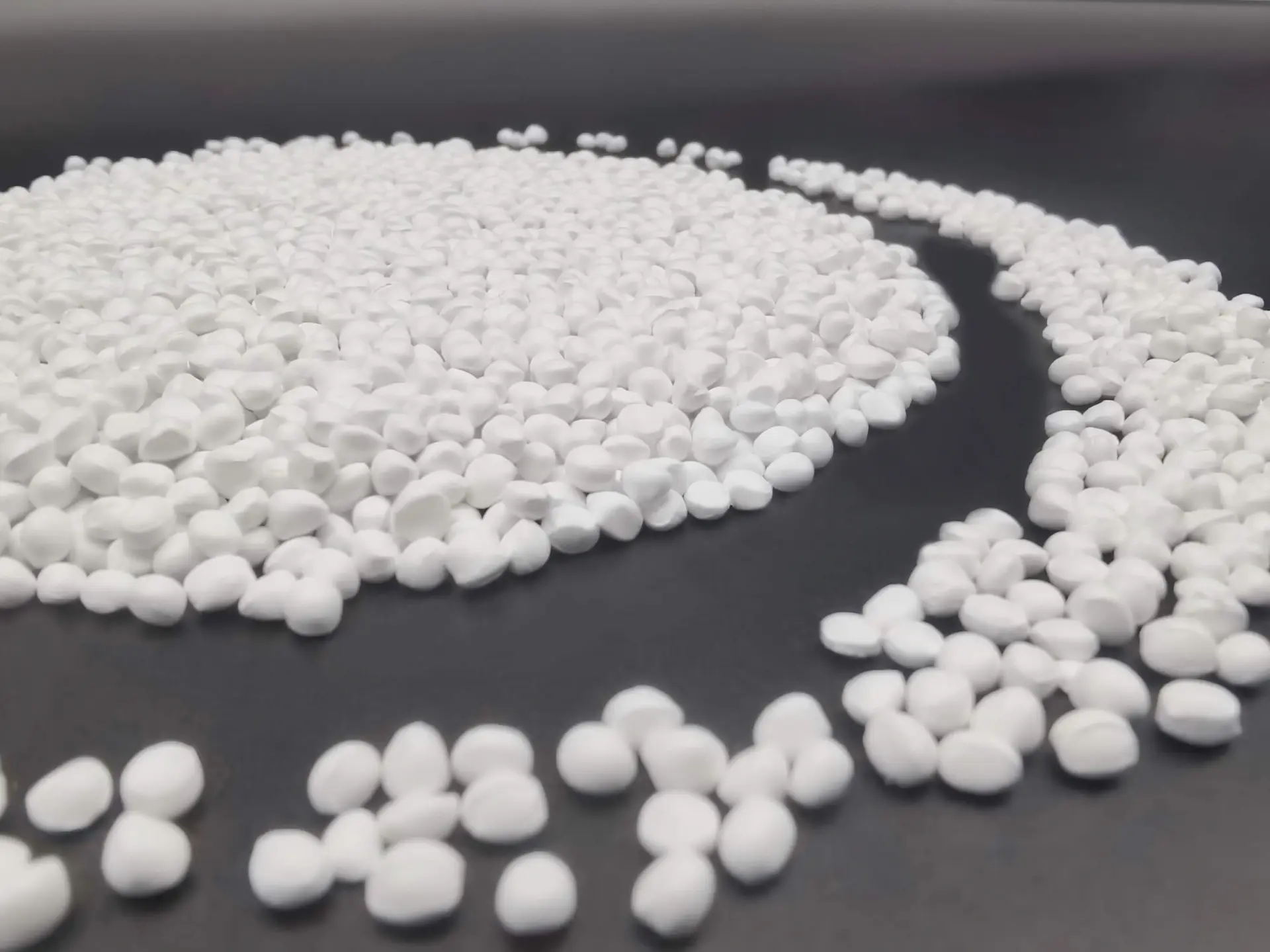
In ultra-thin blown film extrusion (down to 12–15 microns), a pinhole defect occurs when undispersed pigment agglomerates or foreign contaminants exceed the structural gauge of the film layer. During the high-shear bubble expansion phase, these unplasticized clusters create localized stress fields, preventing the polymer melt from drawing down uniformly. Utilizing a highly specified thin film white masterbatch with an engineered organic surface treatment is the critical technical pathway to guarantee a flawless moisture barrier and eliminate web breaks during high-speed wind-up operations.
Running a 15-micron white film on a high-speed blown film line leaves zero room for process variance. At this gauge, minor formulation errors instantly manifest as catastrophic failures: microscopic pinholes that compromise the package barrier, or recurring web breaks that force costly line shutdowns. When a bubble collapses at thin gauges, extrusion operators frequently lower head temperatures or slow down the line—tactics that merely mask the true issue while destroying operational efficiency.
The structural integrity of ultra-thin flexible packaging relies directly on the dispersion of TiO2 inside the melt. This technical analysis outlines the rheological and mechanical mechanisms required for pinhole prevention in extrusion, allowing converters to maximize output rates on thin-gauge runs.
1. The Geometry of a Pinhole: Why Agglomerates Collapse the Bubble
To understand why thin-gauge films tear, we must examine the physical cross-section of the bubble during the blow-up ratio (BUR) phase. When the molten polymer exits the die lip, it is drawn vertically and expanded horizontally, stretching the polymer chains to their physical limit.
If your white masterbatch contains Titanium Dioxide particles that have coalesced into 20-micron or 30-micron agglomerates, these clusters behave like solid stones inside a liquid matrix. As the film wall stretches down to 15 microns, the thickness of the polymer layer becomes thinner than the pigment clump itself.
The consequences are immediate:
Localized Stress Concentration: The polymer melt cannot wet out or encapsulate a massive solid agglomerate cleanly. As the film expands, microscopic voids form around the cluster.
Puncture and Tear: These voids quickly propagate into pinholes under bubble pressure. If the shear stress is high enough, a single pinhole will cause a catastrophic web break, bringing the entire tower to a dead stop.
This issue is a frequent bottleneck on packaging lines, similar to the dispersion failures detailed in our Blown Film Troubleshooting Guide for Gels and Black Spots.
2. Critical Metrics: FPV Thresholds for Thin-Gauge Extrusion
When selecting a grade from a White Masterbatch Manufacturer, checking the pigment loading percentage (e.g., 60% or 70% TiO2) is not enough. You must specify the maximum allowable Filter Pressure Value (FPV) under the EN 13900-5 standard.
For standard rigid injection molding or thick sheet extrusion, an FPV of less than 5.0 bar/g is perfectly acceptable. However, for ultra-thin blown films, you must enforce a far stricter material standard:
Thin-Film Quality Mandate: The masterbatch must exhibit an FPV of less than 1.5 bar/g when tested against a fine 14-micron screen pack.
The Structural Result: A low FPV ensures that the sub-micron TiO2 crystals have been completely de-agglomerated during the compounding phase. The masterbatch melts and flows seamlessly through your screen pack without causing pressure spikes, preserving the film’s elongation properties.
3. Rheological Tuning: Carrier Resin and Surface Treatment Chemistry
Achieving an ultra-low FPV requires a deep understanding of polymer interface chemistry. Titanium Dioxide particles are naturally hydrophilic, meaning they tend to attract moisture and clump together. To prevent this inside a polyethylene matrix, two formulation elements are mandatory:
Hydrophobic Surface Coating: The TiO2 used in a premium thin-film masterbatch must be surface-treated with advanced organosilanes or polyols. This organic shell lowers the surface energy of the pigment, allowing it to wet out instantly within the hydrocarbon chains of the base polymer. It prevents the moisture tracking issues that typically require a Defoaming Masterbatch on lines running recycled or damp resins.
Melt Flow Index (MFI) Gradient: The carrier resin of the white masterbatch must possess a significantly higher MFI (typically 20 to 30 g/10min) than the base LLDPE/LDPE resin (which usually ranges from 0.8 to 2.0 g/10min). This viscosity differential creates a controlled shear zone, ensuring that the masterbatch distributes uniformly across the melt stream without creating localized cold spots or viscosity boundaries that weaken the film.
4. Layer Configuration in Multi-Layer Co-Extrusion
In modern 3-layer or 5-layer co-extrusion setups, optimizing where the white pigment sits can drastically reduce your pinhole risks while maintaining high opacity:
The Optimal Layout: Instead of loading the white masterbatch uniformly across all layers, concentrate the titanium dioxide in the core layer (e.g., the “B” layer in an A/B/C structure).
The Technical Edge: Keeping the outer skins (A and C layers) clear of heavy pigment loading ensures that the surface of the film remains perfectly smooth, preventing die drool and minimizing friction over downstream rollers. If your thin-film application also requires high outdoor durability under intense sunlight, this core loading should be paired with targeted stabilizers from our UV and Anti-Aging Masterbatch Portfolio.
Market Relevance: Meeting the Speed and Barrier Demands of Global Logistics
The global flexible packaging sector is moving toward extreme down-gauging to cut material costs and reduce carbon footprints. This shift is highly evident in high-volume production runs for laminated food packaging, courier bags, and hygiene films.
However, down-gauging puts immense stress on processing machinery. If a factory tries to run a 15-micron film using a standard, coarse white masterbatch, the resulting pinholes will compromise the package’s barrier performance. For food packaging, this leads to rapid oxidation and shelf-life failure, bypassing the safety margins established in our FDA and EFSA Compliance Matrix. To compete globally, converters must run thin-gauge lines at maximum RPM without web breaks. This operational stability can only be achieved by using white masterbatches that guarantee sub-micron dispersion of TiO2.
What do you think?
[…] that plague flexible packaging lines, causing pinholes and visual defects as discussed in our High-Dispersion White Masterbatch Production Guide. To eliminate haze, a premium high jetness black masterbatch must undergo multi-stage filtration to […]
[…] Blown Film Lacing and Windows: In thin-gauge recycling runs, steam pockets expand rapidly as the melt exits the die. This creates elongated, un-pigmented clear zones (“windows”) or open tears (“lacing”) that destroy film barrier properties. This failure is as catastrophic to a production run as the pigment agglomerates detailed in our Ultra-Thin Blown Film White Masterbatch Guide. […]
[…] The “Hand-Feel” Penalty: Even if the filaments survive the draw zone, large agglomerates protrude from the fiber surface, creating “hard spots” in the spun web. This destroys the fabric’s softness, making the final hygiene product feel abrasive against the skin. This failure is structurally identical to the pinhole defects analyzed in our High-Dispersion White Masterbatch for Ultra-Thin Films Guide. […]
[…] act as physical stress concentrators—exactly like the agglomerate defects discussed in our Ultra-Thin Blown Film Pinhole Guide. Worse, they create porous micro-channels along the polymer boundaries. When fatty acids touch the […]
[…] This leads to the exact same visual streaking and structural failure mechanisms we diagnose in our High-Dispersion White Masterbatch Production Guide. A true dual-action masterbatch requires specialized dispersive resins that counteract this […]
Comments are closed.